



By Sunil Subramaniam, Financial Sector Veteran & Ex-MD of Sundaram Mutual Fund, Chennai
Since the war broke out in the middle east, the markets have seen challenging times. The NIFTY 50 is down around 8.08% over the last 3 month (as of May 13th). However, one surprising fact stands out – the Nifty Midcap 100 has been flat at 1.22% and the Smallcap 100 has delivered a positive 5.6%!! What accounts for this significant variance, when, in fact, given the lesser free float in the mid and small cap space, we would have expected them to be much more challenged in a volatile environment.
To dig deeper into this, when we look at the 1month performance, the numbers stand out even more starkly. Nifty 50 down 1.80% while midcap 100 is up 4.35% and the small cap 100 is up 7.35%.
Clearly after the initial shock of the war in the. month of March, since April, buying support has been strong in the broader market.
The larger caps have seen continued selling pressure from the FII net outflows of Rs 1.22 lac cr in March and another 70 k cr in April totaling 1.92 lac cr
DIIs have matched this with 1.44lac cr of net buying in March and another 51K cr in April totaling 1.95 lac cr.
So why have large caps underperformed if DII flows have exceeded FII outflows??
To understand the answer let us look at the retail flows that have come into one of the key DII players – the Domestic Mutual Funds (DMFs).
The months of April and May together brought in 79K cr into equity mutual fund coffers. April month flows were only slightly less (-5%) than that of March.

In addition, retail investors have also contributed another 12.7 k cr in hybrid schemes in both the months put together (majority of which gets allocated to buying equities). So that is 90 k cr in the hands of mutual fund managers which is almost 50 %of the DII net purchases in April and May.

What is also important part of this is the steady SIP book accounting for 63K of inflow into MFs in April and May.

So clearly retail investors have clearly reaffirmed their faith in the Indian Economy and the stock market and shown strong resilience in the face of the worst geopolitical crisis the country has faced in many years!!
Now, let us deep dive into the composition of the flows that mutual funds have received to understand the cap curve performance. Within the equities basket 4 categories dominate 80% of the flows!! Flexi caps (26%), Large & Midcap (12%), Midcap (16%) and Small cap (16%). Now, SEBI rules are very clear – 65% of mid and small cap funds aum must be invested in their respective category stocks and at least 35% of Large & Midcap funds in midcap stocks while in Flexi cap funds – fund managers have complete flexibility.
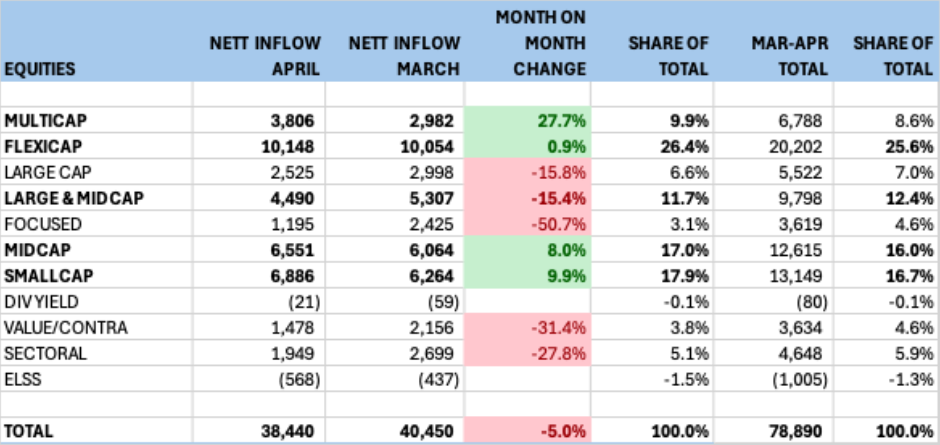
So there lies the answer – retail investors have told fund managers where they must invest a significant proportion of their money – in mid and small cap stocks!!
Add to this the direct retail and HNI investor in equities is probably also choosing mid and small cap stocks to buy after the correction in March.
So, to round off this article, retail investors have not only demonstrated their resilience and faith in the market but have also driven the purchase of mid and small cap stocks and the rally in these segments!!
ps: In the month of May till date FIIs have sold 17.7 K cr but DIIs have more than countered it with double at 35 k cr! So can we expect this outperformance of m id and small caps to continue?
About the author:
Sunil Subramaniam, Former Managing Director and CEO of Sundaram Mutual Fund, is among the most seasoned voices in India’s investment management industry, with a career spanning over four decades across banking, insurance, and asset management. Currently, he advises several investment firms and financial institutions on macroeconomic trends, market strategy and asset allocation among others. He also runs a YouTube channel, ‘Sense and Simplicity by Sunil’, where he breaks down complex market trends, macroeconomic developments, and investment strategies into accessible insights for retail investors.
(Disclaimer: The views expressed are those of the author. Please consult your financial advisor before investing in stocks.)