

DBT Bureau
Pune, 25 May 2026
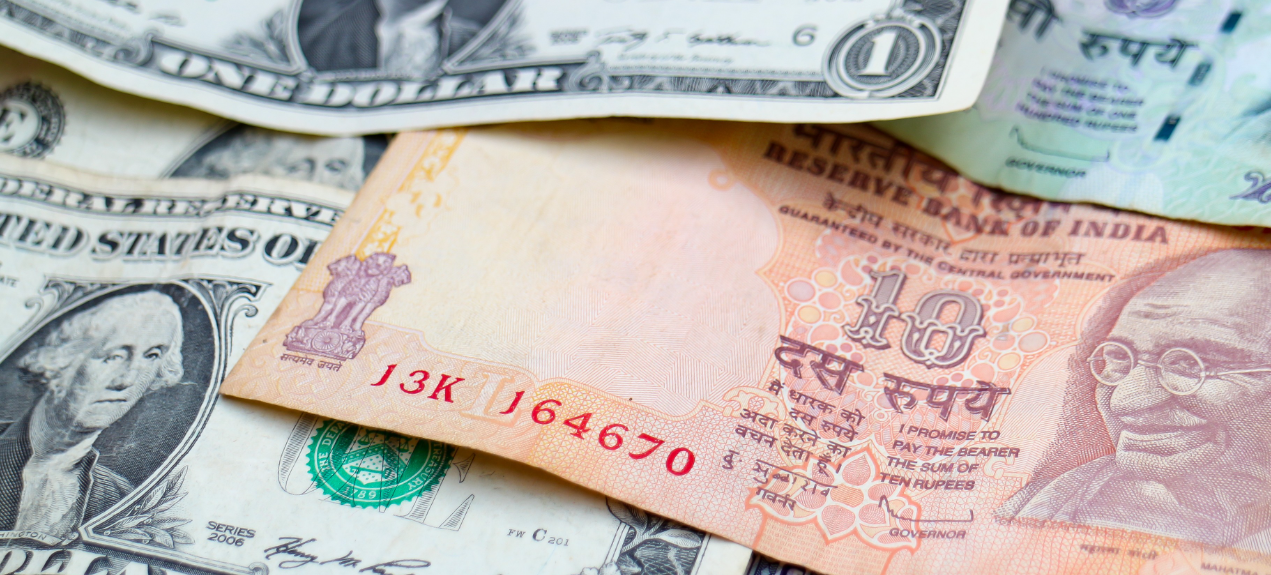
The Indian Rupee has entered one of its most volatile macroeconomic phases in recent history, with USDINR recently touching an all-time high near 95.96, making the rupee one of Asia’s weakest-performing currencies in 2026. The sharp depreciation has been driven by a powerful combination of surging crude oil prices, widening external deficits, aggressive dollar demand, and slowing foreign capital inflows. However, while the broader long-term structure of USDINR remains bullish, technical indicators now suggest that the pair may witness a meaningful corrective pullback toward key support zones before attempting another upward move.
The biggest pressure point for the Indian economy remains crude oil. India imports nearly 85–89% of its crude requirements, making the rupee extremely sensitive to energy shocks. Brent crude has surged above the psychologically critical $100-per-barrel mark for the first time since the 2022 energy crisis, largely due to escalating geopolitical tensions in West Asia and supply disruptions around the Strait of Hormuz. Economists estimate that every $1 rise in crude oil prices increases India’s annual import bill by nearly $1.5–2 billion, significantly widening the Current Account Deficit (CAD).
India’s merchandise trade deficit has simultaneously expanded to a record $333 billion in FY26, with total imports rising toward $775 billion while exports remained relatively stagnant near $442 billion. Elevated imports of crude oil, gold, electronics, edible oils, and industrial components have placed enormous pressure on the country’s dollar reserves and external balance sheet.
On the capital account side, foreign inflows have also weakened considerably. Global investors have increasingly shifted toward AI-led technology economies and export-manufacturing hubs such as Taiwan, Vietnam, and Malaysia under the “China Plus One” strategy. As a result, India’s Balance of Payments position has deteriorated sharply, with several economists projecting the overall BOP deficit near $65 billion during the current cycle. RBI data already showed a balance of payments deficit of $10.9 billion in Q2 FY26, while the broader deficit trend has remained under pressure due to slowing portfolio flows and external uncertainty.
To stabilize the currency, the Reserve Bank of India has actively intervened in the forex market, reportedly selling between $800 million and $2 billion daily during periods of extreme volatility. Despite these interventions, the rupee has continued making record lows as global dollar strength, rising US bond yields, and oil-import demand outweighed central bank defense measures. India’s forex reserves currently stand near $697 billion, still sufficient to cover over 10–11 months of imports, giving RBI a strong macro buffer despite ongoing intervention pressure.
From a technical perspective, USDINR remains in a strong structural uptrend after rallying nearly 10% over the last year. However, the pair recently tested the major 161.8% Fibonacci extension zone near 97.40, where momentum indicators such as MACD are showing bearish divergence — a classic sign that upside momentum is gradually weakening. This increases the probability of a healthy corrective decline in the near term.
The immediate support level for traders now stands at 94.48, which coincides with the 127.2% Fibonacci support zone and previous breakout region. A pullback toward this level would still keep the broader bullish structure intact. However, if RBI intervention intensifies and the government aggressively focuses on inflation control, import management, and liquidity tightening, the correction may extend toward the strong support band of 92.20–92.50 zone.
For now, the long-term trend remains bullish for USDINR, but technically the market appears overextended. Traders should remain alert for a short-term pullback phase, especially as profit booking emerges near historic resistance zones and macro volatility continues dominating currency markets.
Below are the key strengths, weaknesses, opportunities, and threats shaping the outlook for the Indian rupee amid evolving domestic economic conditions and global market uncertainties.
Strengths:
● India forex reserves rose to $696.99 billion on May 8, 2026, supporting rupee stability.
● RBI conducted aggressive dollar sales through state-run banks during May 2026 intervention efforts.
● India services PMI climbed to 58.9 in May 2026, highest since November 2025.
● Infrastructure output growth accelerated to 1.7% in April 2026 from revised 1.2% previously.
● Morgan Stanley projected India’s FY27 GDP growth at robust 6.7% driven by domestic demand.
● S&P stated India possesses sufficient buffers managing wider current-account deficits caused by expensive crude.
● India’s services exports continued rising during May 2026 despite Middle East geopolitical uncertainties.
Weaknesses:
● Rupee weakened beyond 96.90/USD during May 2026 as a deadlock in U.S.-Iran peace talks kept oil prices elevated.
● Indian rupee declined over 6% since Iran war began during late February 2026 period.
● Foreign investors withdrew over $22 billion from Indian assets since Middle East conflict escalated.
● India merchandise trade deficit widened sharply to $28.38 billion during April 2026 month.
● India wholesale inflation surged to 8.3% during April 2026, highest in forty-two months.
● India unemployment rate climbed to 5.2% in April 2026, highest in six months.
● HSBC Manufacturing PMI slipped to 54.3 during May 2026 from 54.7 recorded previously.
Opportunities:
● India considering interest rate hikes during 2026 to stabilize rupee and attract capital inflows.
● Swap markets currently price nearly 100 basis points hikes over next twelve months period.
● Morgan Stanley expects infrastructure investments supporting India’s FY27 economic rebound despite global uncertainties.
● India Ratings projected FY27 GDP growth at healthy 6.7% despite elevated crude oil prices.
● Services sector optimism remained positive during May 2026 amid improving future business conditions expectations.
● Infrastructure demand resilience may support industrial recovery despite elevated inflationary and geopolitical pressures globally.
● Agriculture sector expected improving growth during FY26 fourth quarter despite broader economic slowdown concerns.
Threats:
● Brent crude prices surged over 50% since Iran war erupted during February 2026 period.
● Oil prices nearing $110 barrel threaten India’s balance-of-payments position during FY27 fiscal year.
● India current-account deficit projected rising sharply to 2.3% GDP during FY27 from 0.9%.
● Moody’s reduced India’s 2026 GDP growth forecast by 0.8 percentage points to 6%.
● Retail inflation increased to 3.48% during April 2026 due to higher food price pressures.
● Potential El Nino conditions during FY27 could disrupt agriculture and increase domestic inflationary pressures.
● Persistently weaker rupee may erode foreign investor returns and trigger additional capital outflows.