



DBT Bureau
Pune, 25 July 2026
Crude oil markets are influenced not only by physical supply and demand but also by geopolitical risks, transportation disruptions, refinery dynamics, and regional inventory conditions. Among the various indicators tracked by global energy traders, the Brent–WTI crude oil spread has emerged as one of the most important signals for understanding market stress and geopolitical uncertainty.
The spread represents the price difference between Brent crude oil, the global benchmark, and West Texas Intermediate (WTI), the US benchmark. Under normal conditions, this difference remains relatively stable around $2–3 per barrel, reflecting transportation costs and quality differences. However, during periods of geopolitical tensions or supply disruptions, the spread can widen dramatically as Brent receives a global risk premium.
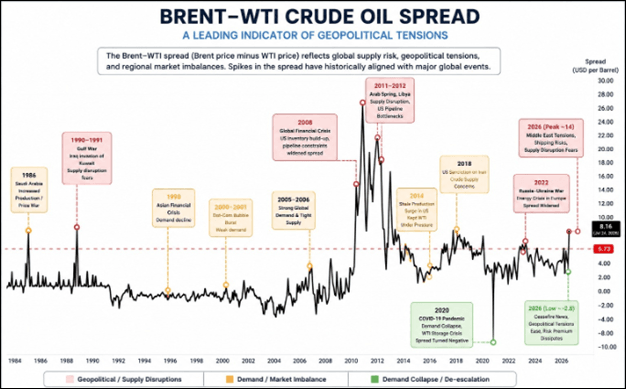
The year 2026 has been a clear example of this phenomenon. The Brent–WTI spread, which was trading near normal levels around $3 per barrel, suddenly surged towards $14 per barrel as geopolitical tensions escalated and markets priced in potential disruptions to global crude supply. However, when ceasefire developments emerged and the immediate risk premium faded, the spread sharply corrected and briefly moved into negative territory near -$2.8 per barrel, highlighting extreme uncertainty and rapid repricing in global oil markets.
This volatility demonstrates why the Brent–WTI spread is not merely a pricing difference but a powerful indicator of geopolitical stress.
Understanding Brent and WTI Crude Oil
To understand the importance of the spread, it is essential to understand the two benchmarks involved.
Brent Crude Oil: The Global Benchmark
Brent crude represents oil produced from the North Sea region and is considered the primary benchmark for international crude oil pricing. Nearly two-thirds of the world’s internationally traded crude oil is priced using Brent as a reference.
Brent is highly sensitive to global events because it reflects international supply-demand conditions. Factors such as:
- Middle East conflicts
- OPEC+ production decisions
- Shipping disruptions
- Global economic growth expectations directly impact Brent prices.
Whenever traders fear a disruption in global oil flows, Brent usually reacts first because it represents the cost of replacing internationally traded barrels.
WTI Crude Oil: The US Benchmark
West Texas Intermediate (WTI) is the benchmark crude oil for the United States. It is a high-quality, low-sulfur crude delivered at Cushing, Oklahoma, which is the major storage hub for US oil.
WTI prices are influenced mainly by domestic US factors such as:
- US shale production
- Crude inventory levels
- Pipeline capacity
- Refinery demand
- Export infrastructure
Unlike Brent, WTI is more sensitive to US-specific supply conditions.
Why Does Brent Usually Trade Above WTI?
Historically, Brent trades at a premium to WTI because it represents globally accessible crude oil, while WTI is influenced by the balance of the US domestic market.
The major reasons include:
1. Global Risk Premium
During geopolitical crises, traders immediately increase exposure to Brent because global supply routes may be affected.
For example:
- Middle East conflicts
- Strait of Hormuz disruptions
- Red Sea shipping risks increase Brent prices faster than WTI, widening the spread.
2. Transportation Differences
WTI is located inland at Cushing, Oklahoma. If pipeline capacity becomes limited, crude can accumulate in storage, pressuring WTI prices.
Brent, being linked to seaborne trade, has greater flexibility to move across global markets.
3. Regional Supply-Demand Imbalance
A rise in US crude production can weaken WTI even when global markets remain tight. Similarly, global supply disruptions can push Brent higher even if US inventories remain comfortable.
Brent–WTI Spread as a Geopolitical Indicator
The spread acts like a market thermometer, showing whether global concerns are increasing or decreasing.
A normal market usually maintains a relatively stable spread. However, sudden expansion indicates that traders are assigning a higher value to globally available crude.
| Brent–WTI Spread | Market Interpretation |
| $2–3 per barrel | Normal market conditions, balanced supply-demand |
| $6–10 per barrel | Rising geopolitical concerns or global supply tightness |
| Above $10 per barrel | Extreme supply risk, major geopolitical disruption |
| Negative spread | Rare situation indicating severe US oversupply or storage pressure |
2026: A Case Study of Extreme Spread Volatility
The recent movement in the Brent–WTI spread highlights how quickly geopolitical developments can influence crude markets.
At the beginning of the period, the spread remained close to historical norms near $3 per barrel. However, as geopolitical tensions intensified and concerns increased regarding possible disruptions to oil transportation routes, Brent crude attracted a strong risk premium.
The spread rapidly expanded, reaching nearly $14 per barrel, indicating that traders were pricing a significant possibility of global supply disruption.
This widening suggested three major market concerns:
- Risk to Middle East crude exports
- Potential disruption in shipping routes
- Higher uncertainty regarding future supply availability
However, once ceasefire discussions and diplomatic developments reduced immediate fears, the risk premium started disappearing.
The spread collapsed sharply, even moving towards negative territory near -$2.8 per barrel. Such a move reflected how quickly markets can unwind geopolitical premiums once perceived risks decline.
This extreme movement highlights that the Brent–WTI spread is not only a pricing mechanism but also a real-time measure of market psychology.
Historical Brent–WTI Spread Spikes
Looking at five decades of historical data, major expansions in the spread have generally occurred during periods of geopolitical instability or significant market distortions.
| Year | Approximate Spread Spike | Major Reason |
| 1990–91 | $8–10 | Gulf War after Iraq invaded Kuwait increased global supply fears |
| 2008 | $10+ | Financial crisis, US inventory build-up and transportation constraints weakened WTI |
| 2011–12 | $20–25 | Arab Spring, Libya supply disruption and US pipeline bottlenecks |
| 2020 | Extreme volatility | COVID-19 demand collapse caused WTI storage crisis and historic weakness |
| 2026 | Nearly $14 | Middle East tensions and shipping risk increased Brent risk premium |
The largest historical movements show a common pattern: whenever global supply security becomes uncertain, Brent immediately reacts while WTI follows domestic US dynamics.
How Traders Use the Spread
Professional traders monitor the Brent–WTI spread because it provides information beyond absolute crude prices.
Rising Spread
A widening spread generally indicates:
- Increasing geopolitical risk
- Stronger international crude demand
- Potential supply disruption
- Higher transportation concerns
Falling Spread
A narrowing spread usually suggests:
- Reduced geopolitical risk
- Improving global supply conditions
- Lower demand concerns
- Better availability of international crude
The spread is therefore used alongside crude prices, inventories, OPEC policy, and shipping data to understand the broader oil market structure.
Current Outlook: Spread Remains Elevated
Currently, the Brent–WTI spread is around $8 per barrel, significantly above the normal historical range of $2–3.
An elevated spread indicates that markets continue to price some level of geopolitical uncertainty. Although immediate tensions may have reduced, traders are still assigning a premium to globally traded crude because supply risks remain present.
Going forward, the key factors determining the spread will be:
- Middle East geopolitical developments
- OPEC+ production decisions
- Global shipping security
- US crude inventory trends
- Demand growth from emerging markets
Conclusion
The Brent–WTI crude oil spread is more than just a price difference between two benchmarks. It is a reflection of global oil market stress, regional supply-demand imbalance, and geopolitical risk.
History shows that whenever the spread expands sharply, markets are usually responding to a significant change in global conditions. From the Gulf War to the Arab Spring, from COVID-related disruptions to the latest geopolitical tensions, the spread has repeatedly acted as an early warning signal.
With the current spread elevated near $8, crude oil markets continue to reflect uncertainty. For investors, traders, and policymakers, monitoring the Brent–WTI spread provides valuable insight into whether geopolitical risks are increasing or gradually fading from global energy markets.
Disclaimer: Any views, opinions, or investment-related information expressed by contributors on Databiztimes.com are solely their own and should not be construed as investment advice. Readers are advised to consult SEBI-registered or certified financial advisors before making any investment decisions,