



By Sunil Subramaniam, Financial Sector Veteran & Ex-MD of Sundaram Mutual Fund
14 Oct 2026, Chennai
India imports over 85% of its crude oil requirements, making crude surges a transmission channel for macroeconomic pressure across the Indian equity landscape.
Historically, crude oil shocks create sharp near-term drawdowns driven by multiple macroeconomic factors, but they do not permanently derail long-term market trends unless coupled with global recessions.
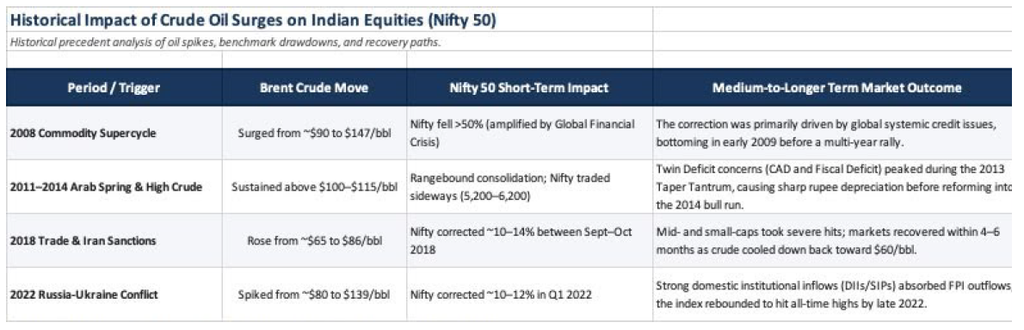
Historical Precedents: How the Indian Market Reacts
Across major oil spikes, the Indian market exhibits a consistent pattern: immediate valuation compression and foreign institutional selling, followed by selective sectoral decoupling, and eventually a strong recovery once prices stabilize.
The Macro Transmission Mechanism
When crude prices surge, four levers impact Indian equities:
1. Trade Deficit & Currency Pressure: Every $10/bbl increase in crude oil generally widens India’s Current Account Deficit (CAD) by roughly 40–50 bps of GDP. A wider deficit increases dollar demand, putting downward pressure on the INR.
2. Imported Cost-Push Inflation: Diesel and petrol price revisions cascade into logistics, manufacturing, and food costs, elevating headline CPI.
3. Monetary Tightening: Persistent inflation curtails the Reserve Bank of India’s (RBI) headroom to cut rates or forces a pause/tightening stance, raising domestic bond yields and increasing discount rates for equity valuations.
4. FPI Outflows: Foreign institutional investors historically treat emerging markets that are net commodity importers as a source of liquidity during energy spikes, rotating capital toward commodity-exporting economies.
Sector-Wise Impact
High Vulnerability (Negative Margin Compression):
Paints, Adhesives & Specialty Chemicals: Crude derivatives constitute 40–50% of raw material costs. Operating margins contract unless companies pass on pricing directly.
Aviation: Aviation Turbine Fuel (ATF) makes up 35–45% of airline operational expenses.
Tyres: Synthetic rubber and carbon black are petroleum-derived; rising input costs strain gross margins.
Oil Marketing Companies (OMCs): Downstream retail margins face political resistance to frequent fuel price hikes during sharp spikes.
Direct Beneficiaries:
Upstream Oil & Gas Exploration: Producers gain directly from higher net crude realizations.
Resilient / Neutral:
Large Private & Public Sector Banks: Insulated directly from commodity prices, though elevated bond yields can induce treasury mark-to-market losses.
IT Services & Exporters: A weaker rupee acts as a natural margin buffer for dollar-earning tech and pharma companies.
How Retail Equity Investors Should Navigate the Market
1. Avoid Panic-Stopping Systematic Investment Plans (SIPs)
Historical data demonstrates that stopping equity SIPs during geopolitical or commodity-driven drawdowns impairs rupee-cost averaging. In past shocks (2018 and 2022), the units accumulated during elevated crude periods yielded superior returns once supply-demand normalized.
2. Conduct a Portfolio “Petrochemical & Input” Stress Test
Review discretionary exposure. Companies in input-heavy sectors (paints, aviation, mid-tier chemical producers) lacking pricing power or cash reserves face margin compression over 2–3 quarters. Rebalance toward firms with balance sheets strong enough to withstand temporary margin hits.
3. Resist Chasing Cyclical “Hedges” Late
Retail investors often buy upstream energy producers or commodity ETFs after crude has already surged past historical averages. Upstream earnings are tied to windfall taxes and sharp corrections if tensions ease or demand contracts.
4. Stagger Capital Deployments via Tranches
If deploying fresh lump-sum cash, avoid all-or-nothing market timing. Divide investable surpluses into 3–4 tranches spread over 60–90 day periods to capitalize on index consolidation and broader valuation compression across quality large-caps.
About the author:
Sunil Subramaniam, Former Managing Director and CEO of Sundaram Mutual Fund, is among the most seasoned voices in India’s investment management industry, with a career spanning over four decades across banking, insurance, and asset management. Currently, he advises several investment firms and financial institutions on macroeconomic trends, market strategy and asset allocation among others. He also runs a YouTube channel, ‘Sense and Simplicity by Sunil’, where he breaks down complex market trends, macroeconomic developments, and investment strategies into accessible insights for retail investors.
Disclaimer: Any views, opinions, or investment-related information expressed by contributors on Databiztimes.com are solely their own and should not be construed as investment advice. Readers are advised to consult SEBI-registered or certified financial advisors before making any investment decisions.