



DBT Bureau
Pune, 29 Sep 2026
U.S. Henry Hub natural gas futures are on track to register a second consecutive monthly gain, supported by stronger flows to liquefied natural gas (LNG) export facilities and the approach of the seasonal winter demand period. Earlier in the year, record domestic gas production coupled with mild spring temperatures enabled utilities to maintain inventory levels well above historical norms. Storage surplus peaked in April at approximately 7.7% above the five-year seasonal average. However, persistent hotter-than-normal summer temperatures significantly increased power-sector gas consumption, as utilities drew down inventories to meet elevated electricity demand from air-conditioning usage. Natural gas remains a critical fuel source for the U.S. power sector, accounting for nearly 40% of total electricity generation. As a result of stronger summer demand, the storage surplus has narrowed considerably, with current U.S. natural gas inventories standing around 2.9% above the five-year seasonal average.
Europe’s natural gas storage facilities, which act as a key buffer against supply disruptions and price volatility during the winter heating season, are currently about 69% full. This remains significantly below the five-year average of approximately 85% for the same period. The United States has remained a major supplier of LNG to Europe in recent years, helping the region reduce its dependence on traditional pipeline sources. Market conditions have tightened further following disruptions to LNG shipments through the Strait of Hormuz amid the ongoing Iran-U.S. conflict. The supply concerns pushed benchmark European gas prices above their highest level in nearly three years.
Natural gas prices are expected to remain supported by seasonal demand, robust LNG exports, and concerns over global supply disruptions. While U.S. inventories remain above historical averages, the surplus has narrowed substantially following strong summer consumption. Meanwhile, lower-than-average European storage levels and geopolitical risks affecting LNG trade routes could continue to provide upside support to global natural gas markets in the near term.
U.S. Natural Gas storage
The U.S. Energy Information Administration reported that underground natural gas storage levels stood at 3351 billion cubic feet as of September 18. Storage levels were 4.2% below that recorded during the same period last year and 2.9% above the 5-year seasonal average.
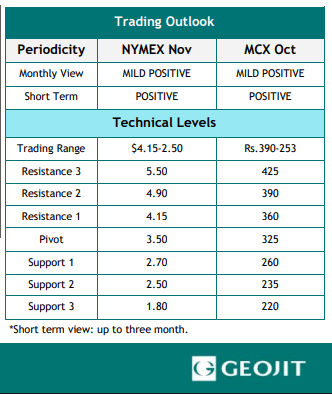
NYMEX Natural Gas: The MACD indicator is showing bullish divergence, indicating potential for further upside in the near term. However, the $3.50 level may continue to act as a strong resistance zone, potentially triggering corrective declines.
MCX Natural Gas: MACD bullish divergence indicates underlying positive momentum and suggests scope for further upside. However, sustained strength may emerge only if prices break and hold above the ₹325 level. Failure to clear this key resistance zone could invite renewed selling pressure and trigger a corrective decline.
Disclaimer : Investment in securities & commodities market are subject to market risks, read all the related documents carefully before investing
Source: Geojit Investments Limited