


By Sadananda Mohapatra, Senior Business Journalist
Can India’s Grid Keep Up With Its Own Clean Energy Ambition?
Reliance Industries is building what may be India’s most consequential renewable energy project: a solar and battery storage hub spread across roughly 550,000 acres of arid land in Kutch, Gujarat. Once fully operational, the facility targets over 40 billion units of green electricity annually, equalling nearly 3% of India’s current total power demand. EPC contracts for a dedicated Kutch-Jamnagar transmission corridor have already been awarded, with power contribution expected to begin in the first half of FY27. The project is a striking symbol of India’s clean energy momentum. It is also an uncomfortable spotlight on a problem the sector has yet to solve.
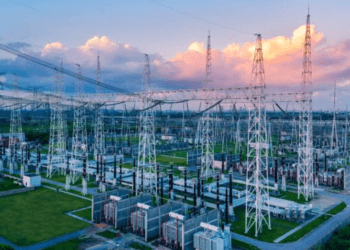
India is generating renewable energy faster than its grid can carry it. In Q1 2026 alone, the country curtailed approximately 300 GWh of renewable power due to transmission constraints, accounting for nearly two-thirds of total RE curtailment of around 470 GWh for the period, according to energy think tank Ember. The Western and Northern regions absorbed the heaviest losses. In Rajasthan, roughly 23 GW of commissioned renewable capacity is running against an evacuation margin of only 18.9 GW, leaving over 4 GW effectively stranded during peak solar hours.
The structural mismatch is not difficult to explain. A utility-scale solar project can be commissioned in 12 to 18 months. The transmission infrastructure required to evacuate its output takes 36 to 60 months to build, complicated further by Right-of-Way land acquisition disputes and inequitable grid access rules that leave merchant RE projects bearing a disproportionate share of curtailment. Coal-fired plants add to the pressure as their need for continuous minimum-load operation forces renewable curtailment even when clean power is available. As of mid-2026, approximately 25% of planned transmission projects for FY26-27 are delayed by over a year, with around 20 GW of renewable capacity facing active connectivity delays.
Even Reliance’s Kutch project, better insulated than most with captive demand from an on-site refinery and green hydrogen facility, heavy battery storage for round-the-clock supply, and its own dedicated corridor, will eventually test the wider grid’s readiness as it scales toward full capacity. Projects without those advantages face the grid’s limitations directly and immediately.
The government is not standing still. At least policy wise. Green Energy Corridor Phases 3 and 4 are being planned to evacuate 150 GW of renewable energy, supporting India’s target of 500 GW of non-fossil capacity by 2030. Around 192 GW of transmission capacity is currently under implementation, with a further 72.6 GW under planning through 2030. The challenge is execution speed: in FY2025, only 8,830 circuit kilometres of new transmission lines were commissioned against a target of 15,253 circuit kilometres, a 42% shortfall, with inter-state transmission additions at their lowest in a decade.
India cannot afford to slow renewable deployment. Demand is growing strongly and coal cannot carry the load indefinitely. But generation ambition without parallel transmission investment, storage scale-up and coal flexibility reforms risks turning a growing share of green power into curtailed megawatts. Reliance’s Kutch hub is a powerful statement of intent. Whether the grid is ready to receive it is a different question entirely.
Joules Capsule
Quick reads from the world of energy this week
Tata Power Plans Rs 15,000 Crore Mumbai Grid Upgrade on Data Centre Surge
Tata Power has announced a Rs 15,000 crore [$157.2 million] investment by 2029 to modernise Mumbai’s transmission and distribution network. Peak demand in the city currently stands at approximately 4,642 MW and is projected to reach 6,500 MW by 2031, driven largely by data centre expansion. The plan includes doubling Battery Energy Storage System capacity to 200 MW by FY27, raising the clean energy share to 70% by 2031, and adding hydropower, solar and smart meter capacity. The announcement signals how data centre growth is now directly reshaping urban power investment priorities across India.
India’s First Coal Washery Monetisation Signals Shift on Coking Coal
Bharat Coking Coal Limited handed over its 2 million tonne per annum Dugda Coal Washery in Dhanbad, Jharkhand to JSW Steel on June 17, marking India’s first coal washery asset monetisation under the Ministry of Coal’s programme. The transfer aims to modernise operations, increase washed coking coal supply for the steel sector and advance Mission Coking Coal’s import substitution goals. BCCL shares rose up to 10% on the announcement. Modest in scale, the transaction matters as a policy template: India imports roughly 90% of its metallurgical coal needs despite holding 37.37 billion tonnes of domestic reserves.
Tamil Nadu Commits Rs 15,032 Crore to Power Infrastructure
The Tamil Nadu government announced on June 16 a Rs 15,032 crore [$157.5 million] investment to expand the state’s power infrastructure. The plan covers 121 ongoing and 231 new or upgraded substations designed to support rising electricity demand, renewable energy integration, Battery Energy Storage Systems and thermal and hydro capacity additions. The announcement signals Tamil Nadu’s recognition that generation ambition requires matching grid investment — a lesson playing out at the national level as transmission bottlenecks continue to constrain renewable evacuation across India’s Western and Northern regions.
Gujarat Commissions 210 MW Solar Project at Jamnagar
Gujarat State Electricity Corporation Limited has commissioned a 210 MW grid-connected solar project at Babarzar in Jamnagar district, developed on government wasteland. The project has signed a 25-year power purchase agreement with Gujarat Urja Vikas Nigam Limited at a tariff of Rs 1.76 per kWh, among the more competitive solar tariffs in recent state-level auctions. Power evacuation will use existing transmission infrastructure, keeping project costs lean. The Jamnagar location places the facility in proximity to Reliance’s Kutch renewable hub, reinforcing Gujarat’s position as India’s most active renewable energy corridor.
About the Author:
Sadananda Mohapatra is a veteran business journalist with decades of experience covering India’s energy, industry, and economic landscape. With stints at reputed financial news publications like The Business Standard & NewsWire18, he reported extensively on India’s power sector, minerals policy, coal and energy regulation, and industrial developments — building a deep, ground-level understanding of the global energy economy. His work spans corporate affairs, infrastructure, and policy analysis, with a particular focus on eastern India’s resource-rich industrial corridor. He currently writes on the global energy landscape through his newsletter, The Joule’s Stack.