


By Sunil Subramaniam, Financial Sector Veteran & Ex-MD of Sundaram Mutual Fund ,Chennai
The current market volatility has been caused by the outbreak of war between Israel, America and Iran in the end of Feb 2026. With India not being involved in the war in any way and the expectation of this being a short war given the military superiority of Israel and America, initially there was an expectation that the impact would be sharp but recovery would happen quickly.
This was, however, belied by the strength of the Iranian resistance and as of Mar 30th the war does not appear to be heading for a finish very soon.
Hence, the consequences on the Indian Market have been very severe with the Nifty down 10% in a month to close at 22331,
The main reasons for the market volatility (the VIX, the volatility index is at 27.88 (it was below 10 in early January) can be attributed to the rise in oil prices to 113 USD (Brent crude is up 54% over the last month), India relying on Imports for more than 85% of its requirements, FIIs pulling out 1.22 lakh crore in March, flight to safety in the USD with the Dollar Index (DXY) touch 100, and the consequent weakening of the Indian Rupee to 94.77. Though DIIs put up a stiff fight with net purchases of Rs 1,43 lakh crore, it not enough to prevent a sharp fall in the Indices. In fact, the Nifty Midcap 100 and the Nifty Smallcap 250 have also fallen by 9.3% and 8.3% respectively.
Naturally, investors ‘portfolios have uniformly suffered.
Investors need to understand how markets have reacted in the past to similar geopolitical events before they panic.
For eg the Russia – Ukraine war in Feb 2020 is an apt example as Crude Oil prices similarly spiked (all the way up to 140 USD).
• Market Reaction: On the day of the invasion (Feb 24, 2022), the Sensex crashed by 2,702 points (4.7%). Over the first 20 days of the war, the index saw a cumulative drawdown of nearly 4,000 points.
• Recovery Time: Despite the initial crash The Sensex reported near-zero abnormal returns within 10 trading days, though volatility lasted a few months.
This time around the initial correction was not so sharp because of the strong DII flows , but the correction has lasted longer because of
The “Hormuz” Factor:
If the Strait is effectively closed, 20% (40 to 45% for India) of global oil supply is at risk.
Key Takeaways for Judging Corrections
• The “Oil” Factor: Geopolitical events that threaten energy prices (like Russia-Ukraine) cause deeper and longer corrections in India
• Panic is Front-Loaded: Most of the “correction” happens in the first 24–72 hours of the news.
• The “3-Month” Rule: Historically, Nifty returns 3 to 6 months after a geopolitical shock are almost always positive (~ 7% to 19%)
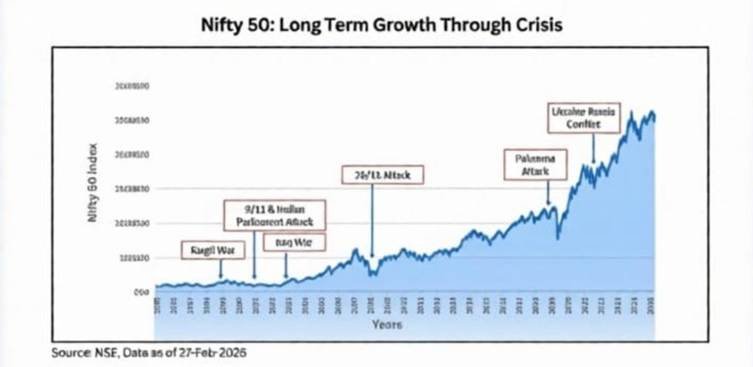
The above image shows you that despite such sharp corrections due to geopolitical events, the trajectory of the Nifty has always been positive when the situation normalizes.
Investors have found it hard to understand this volatility as the Indian Economy has been broadly performing well with a 7% GDP growth rate which makes it the ‘fastest growing major economy’ in the world!
They need to understand that the dynamics of the market is a reflection of both
1. the ‘value” which is the growth of the economy and of the earnings of companies listed in the stock market and
2. the ‘price’ that large institutional investors (FIIs and DIIs) are willing to pay for it. The price is a function of the ‘potential to generate future profits from the investment compared to a basket of alternative opportunities available’.
The spike in Oil prices and the weakening of the rupee are likely to impact, in the short run, the ‘value’ – the economic growth and the earnings of companies and consequently their valuations (the ‘price’ they are willing to pay for it).
However, as and when the war gets over, and/or oil prices stabilize, the Indian economy will revert to its long run rate of growth and companies’ earnings will follow suit. Even through this crisis the Indian economy continue to remain the fastest growing major economy in the world.
Hence, as an investor, you need to understand that this volatility is temporary, but it can get worse before it gets better.
So your actions should be taken based on 1, the expected time frame of your investment or 2. Your risk appetite (ability to understand and tackle volatility) is either ‘moderate’ or ‘aggressive’.
Here are suggested courses of action based on the scenarios:
- Your outlook is short term ie you need the money (already invested in the stock market) over the next 3 to 6 months for a planned expenditure for which you have been saving over a period of time – In such a case it is advisable to redeem your investments to the extent necessary to meet those expenses and park the proceeds in a liquid fund or an arbitrage fund.
- Your outlook is medium to long term and you have a ‘moderate’ risk appetite – Do nothing. Do not panic and redeem. Do not try to switch sectoral allocations (sell something and buy something else)
- Your outlook is medium to long term and you have an ‘aggressive’ risk appetite – you can start allocating 1% of your free cash flows (if any) daily to buy Stocks or Mutual funds in exactly the same proportion that you held as per your Asset Allocation before the war started. Your money will be spread over a 100 day period (approx. 5 Months assuming 20 working days a month), by which time the war related impact should settle down, This will result in bringing down the ‘average’ cost of your portfolio and enhancing the returns from the same when the original time frame is reached.
About the author:
Sunil Subramaniam, Former Managing Director and CEO of Sundaram Mutual Fund, is among the most seasoned voices in India’s investment management industry, with a career spanning over four decades across banking, insurance, and asset management. Currently, he advises several investment firms and financial institutions on macroeconomic trends, market strategy and asset allocation among others. He also runs a YouTube channel, ‘Sense and Simplicity by Sunil’, where he breaks down complex market trends, macroeconomic developments, and investment strategies into accessible insights for retail investors.
(Disclaimer: The views expressed are those of the author. Please consult your financial advisor before investing in stocks.)