

DBT Bureau
Pune, 22 Nov 2026
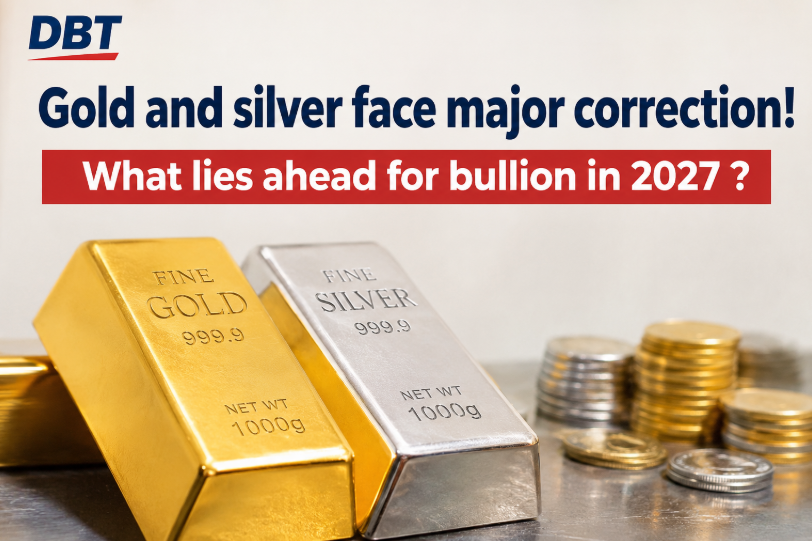
Gold and silver prices have fallen sharply from their record highs in January 2026. However, strong buying by central banks and continued investment in gold exchange-traded funds (ETFs) suggest that the long-term demand for precious metals remains healthy, according to a report by Kedia Advisory.
The recent correction has changed the market outlook in the short term, but the reasons supporting gold’s long-term demand remain largely unchanged.
The report expects gold prices to stabilise first before moving towards a gradual recovery. However, it cautioned that a strong recovery is not guaranteed and will depend on global economic conditions.
Gold and silver fall sharply from record highs
Gold and silver have witnessed a major correction after reaching record levels in January 2026.
COMEX gold fell around 36.4% from its 12-month high of $5,626.80 per ounce to $3,581 per ounce as of November 20.
Silver faced a much sharper decline. COMEX silver dropped around 65.3% from its high of $121.79 to $42.31 per ounce.
On the domestic market, MCX gold declined from its peak of ₹1,80,779 per 10 grams to ₹1,23,431. MCX silver also fell sharply from ₹4,20,048 per kg to ₹1,51,648.
The report said silver has fallen almost twice as much as gold, reflecting its higher price volatility and exposure to industrial demand.
Strong US dollar and higher interest rates pressure gold
One of the main reasons behind the recent decline is the change in US monetary policy.
Higher US Treasury yields and a stronger dollar have reduced the attractiveness of gold. Unlike bonds and bank deposits, gold does not provide regular interest income. Therefore, investors may prefer interest-bearing assets when interest rates remain high.
The US 10-year Treasury yield increased from 4.13% in November 2025 to 4.99% in November 2026. Meanwhile, the US dollar index reached 103.89, close to its highest level in the past year.
Inflation in the US has also remained above the Federal Reserve’s 2% target. Headline PCE inflation stood at 3.6%, while core PCE inflation was 3.1%.
Strong employment data and economic growth have also reduced expectations of aggressive interest rate cuts.
Kedia Advisory said gold could face further pressure if inflation remains high and US interest rates stay elevated.
Central banks continue to buy gold
Despite the fall in prices, central banks remain important buyers of gold.
According to the World Gold Council data cited in the report, central banks purchased 321 tonnes of gold in the third quarter of 2026.
Their total purchases reached around 675 tonnes during the first nine months of 2026, up 6% compared with the same period last year.
Countries are increasing their gold holdings to diversify foreign exchange reserves and reduce their dependence on a single currency.
Gold is also considered an important reserve asset because it does not depend on the financial strength or repayment ability of any particular country.
However, Central bank purchases could slow if prices remain expensive or some countries need to sell gold to meet their financial requirements.
Global gold ETF investment remains strong
Investment demand has also remained supportive despite the price correction.
Global gold ETF holdings reached a record 4,275 tonnes at the end of October 2026, compared with 3,932 tonnes at the end of November 2025.
Gold ETFs recorded net inflows of around $41 billion between January and October 2026. Holdings increased by 246 tonnes during the same period.
In October alone, global gold ETFs received $2.7 billion in net inflows, adding 19 tonnes to their holdings.
The Indian market has also seen strong investment demand.
Assets under management (AUM) of Indian gold ETFs increased 76.2% year-on-year to ₹1,79,894 crore in October 2026, compared with ₹1,02,120 crore in October 2025.
This shows that investors are continuing to use gold as an investment option even after the recent price decline.
India’s gold imports decline sharply
While investment demand remains strong, India’s physical gold imports have fallen significantly.
Gold imports declined 62.6% year-on-year to $5.51 billion in October 2026, compared with $14.72 billion in October 2025.
The report attributed the decline to several factors, including higher gold prices, changes in import duties and differences in Diwali timing between the two years.
India’s effective gold import duty increased from 6% to 15% in May 2026, raising the cost of imported gold.
However, the report cautioned that a single month’s import data should not be treated as a clear indication of a long-term demand slowdown.
Why MCX gold is performing better than international prices
Interestingly, domestic gold prices have remained relatively stable compared with international prices.
Between November 2025 and November 20, 2026, COMEX gold declined 11.78%, while MCX gold gained around 0.26%.
The weaker Indian rupee has helped support domestic prices. The rupee moved from ₹88.69 against the US dollar in November 2025 to ₹92.66 in November 2026.
A weaker rupee increases the cost of importing gold, which can limit the impact of falling international prices on the Indian market.
The increase in import duty has also supported domestic gold prices.
Silver faces higher volatility
According to leading financial analysts, silver has a different demand structure compared with gold.
Apart from investment demand, silver is widely used in solar panels, electrical equipment, electronics and the automobile industry.
This makes silver more sensitive to changes in industrial activity and global economic growth.
The gold-silver ratio, which measures how many ounces of silver are needed to buy one ounce of gold, increased to 84.22 from 79.36 in November 2025.
A rising ratio indicates that gold is performing better than silver.
Silver could recover if gold prices improve and industrial demand becomes stronger. However, investors should not assume that silver will recover faster than gold.
Three possible scenarios for gold in 2027
Base case: Gold may trade within a broad range before moving towards a gradual recovery. This scenario depends on inflation easing, US bond yields stabilising and central banks continuing to buy gold.
Bullish case: Gold could see a stronger recovery if inflation falls, the US dollar weakens and the Federal Reserve adopts a more supportive monetary policy. Higher ETF investments could provide additional support.
Bearish case: Gold may remain under pressure if inflation stays high, interest rates rise further and investors reduce their exposure to gold ETFs.
The report considers gradual stabilisation followed by a recovery as the base case, rather than another sharp rally similar to the one seen in January 2026.
Institutional forecasts point to higher gold prices
The long-term outlook for gold remains positive, with major financial institutions expecting prices to move higher by the end of 2027.
J.P. Morgan Private Bank expects gold to reach around $4,600 per ounce by the end of 2027, while UBS has reportedly projected a price of $5,000 per ounce.
However, these are institutional estimates and actual prices will depend on market conditions.
Gold outlook: Stabilisation before recovery
After the sharp rally and subsequent correction, the gold market is entering a period of adjustment. Higher US interest rates, a stronger dollar and persistent inflation continue to create pressure on prices.
However, continued buying by central banks and strong investment demand through gold ETFs remain important factors supporting the long-term outlook.
The market is expected to move through three stages: correction, consolidation and gradual recovery.
For investors, patience and disciplined buying will be important during this period. Spreading purchases over time instead of investing the entire amount at one price can help manage market volatility.
Investors should also remain cautious about leveraged positions, as sharp price movements can increase the risk of losses.
Overall, gold’s long-term investment appeal remains intact, but a sustained recovery will depend on lower US real interest rates, a stable dollar and continued institutional and central bank demand.
Disclaimer: Any views, opinions, or investment-related information expressed by contributors on Databiztimes.com are solely their own and should not be construed as investment advice. Readers are advised to consult SEBI-registered or certified financial advisors before making any investment decisions.