

DBT Bureau
Pune, 17 June 2026
For decades, global geopolitics revolved around a single commodity—crude oil. Oil dictated inflation, influenced foreign policy, shaped trade routes, triggered conflicts and determined the economic fortunes of nations. Even today, whenever geopolitical tensions emerge in the Middle East, the first reaction across financial markets is seen in crude oil prices because energy remains the lifeblood of modern economies.
The recent tensions in the Middle East once again reminded us how sensitive global markets remain to disruptions in energy supply. Concerns over shipping routes, energy availability and inflationary pressures quickly pushed crude oil back into the spotlight. Yet while the world remains focused on energy security, another equally important and potentially more powerful theme is emerging beneath the surface—food security.
After all, economies can temporarily adjust to higher energy costs, but no nation can survive without food. Manufacturing, technology, artificial intelligence, digital economies and financial markets all ultimately depend upon one fundamental requirement: agriculture.
The global conversation is therefore gradually shifting from energy security alone to a broader framework encompassing food security, feed security and edible oil security. In this evolving landscape, agriculture is no longer merely a rural sector—it is becoming a strategic geopolitical asset.
Understanding the Commodity Supercycle: Why Agriculture Always Comes Last—and Matters Most
Throughout modern economic history, commodity supercycles have followed a remarkably consistent pattern. Whether during China’s industrial expansion, global infrastructure booms or periods of geopolitical disruption, the sequence of market reactions has often remained similar.
The first commodity to react is almost always crude oil. As the world’s primary energy source, oil immediately reflects geopolitical tensions, supply disruptions and economic uncertainty.
The second stage typically involves precious metals. As rising energy costs fuel inflation and uncertainty, investors seek protection through gold and silver. These metals function as stores of value and safe-haven assets during periods of elevated risk.
The third phase shifts toward industrial and base metals such as copper, aluminium, zinc and nickel. As economic activity expands and infrastructure investment accelerates, demand for industrial commodities rises sharply. This is why copper is often referred to as the metal with a PhD in economics—it reflects the health of global growth.
However, the final and often most important phase of every commodity supercycle belongs to agriculture.
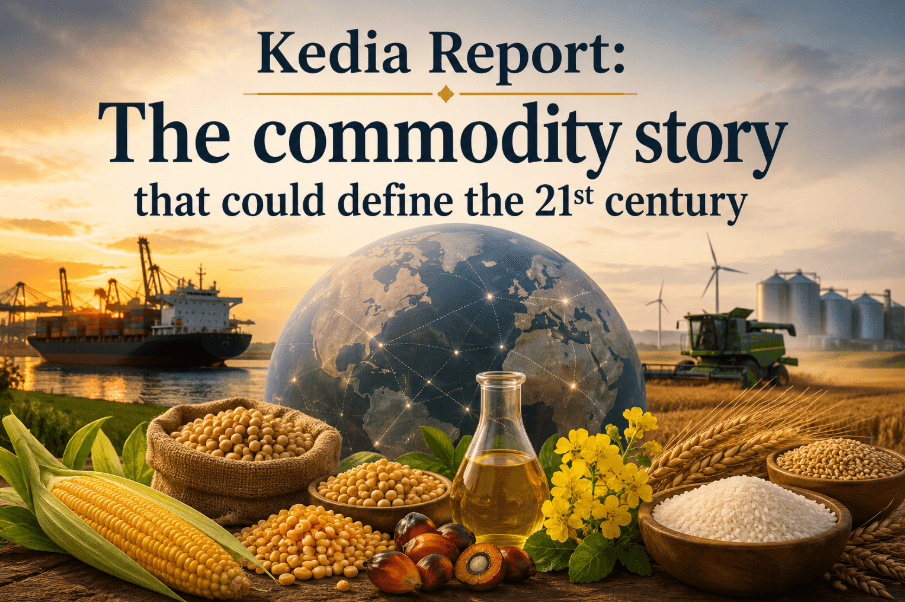
Unlike energy or metals, food consumption cannot be postponed. Every stage of economic development ultimately increases demand for food, feed and edible oils. Rising incomes drive higher protein consumption, boosting demand for feed grains such as maize and soybean meal. Population growth increases demand for staple foods. Meanwhile, the global energy transition is creating additional demand for vegetable oils through biodiesel and sustainable aviation fuel programs.
History repeatedly demonstrates that while crude oil may trigger inflation and metals may build economies, agriculture sustains them. It is the final layer of every commodity cycle because it supports the most fundamental requirement of all economic activity—human survival.
This is why agriculture should no longer be viewed as merely another commodity sector. It is the foundation upon which every commodity supercycle ultimately rests.
Why the 2026 BRICS Summit Matters for Agriculture
As India chairs BRICS in 2026, investors, policymakers and commodity participants should closely watch the developments emerging from the bloc. India formally assumed the BRICS Chairmanship on January 1, 2026, and will host the 18th BRICS Summit later this year.
This is particularly significant because the future of global agriculture is increasingly concentrated within BRICS nations. The expanded BRICS grouping represents nearly half of the world’s population, around 40% of global GDP and a substantial share of global agricultural production, consumption and trade.
India’s chairmanship arrives at a crucial moment. Climate disruptions, rising food inflation, edible oil dependence, weather-related risks and changing trade patterns have elevated agriculture from a development issue to a strategic national priority.
In many ways, BRICS is evolving into what OPEC once represented for oil markets—a powerful coalition capable of influencing global food, feed and agricultural oil flows through production, trade, logistics, investment and policy coordination.
Together, these nations possess enormous influence over the future direction of global agricultural markets.
Food, Feed and Oil: The Three Pillars of Agricultural Power
The global agricultural economy is built upon three interconnected pillars.
Food: Food remains the foundation of human survival. Rice, wheat, pulses and staple grains support the nutritional requirements of more than eight billion people worldwide. Any disruption in production directly affects food inflation, trade flows and social stability.
Feed: As incomes rise across emerging economies, consumption patterns increasingly shift toward protein-rich diets. This drives demand for poultry, dairy and livestock products, making maize and soybean meal critical components of global feed supply chains.
Oil: The most strategically important pillar today is agricultural oil. Palm oil, soybean oil, sunflower oil, mustard oil and rapeseed oil are no longer just cooking ingredients. They have become essential commodities linking food consumption, renewable energy and energy security. This dual demand creates a unique dynamic where vegetable oils are influenced not only by food consumption but also by biodiesel mandates, sustainable aviation fuel programs and decarbonization policies. As a result, edible oils have emerged as one of the most strategically sensitive agricultural commodity segments globally.
Climate Risk: The New Driver of Agricultural Markets
Unlike crude oil, metals or manufactured products, agriculture operates in an open-air factory.
Weather remains the single largest variable affecting agricultural production.
The world is currently experiencing increasing climate volatility through heat waves, erratic rainfall, floods, droughts and changing weather patterns. Concerns surrounding El Niño-related disruptions and extreme weather events continue to influence crop productivity across major producing regions.
Even a small decline in agricultural output can trigger disproportionately large price reactions because food demand is highly inelastic.
When weather threatens domestic supplies, governments frequently respond with export restrictions, tariffs, minimum export prices and stock controls. While such measures may protect domestic consumers, they often create shortages and inflationary pressures for importing nations.
In this environment, climate risk has become one of the most powerful drivers of agricultural commodity prices.
Why Agricultural Volatility Matters to Corporates
Agricultural price fluctuations are no longer just a farmer’s concern.
Today, agricultural commodities directly impact corporate profitability across multiple industries.
Food processors depend on grains, edible oils and sugar. Poultry and dairy companies rely heavily on maize and soybean meal. Textile manufacturers depend on cotton. Biofuel producers require vegetable oils. Spice exporters, FMCG companies and agribusinesses all face input-cost risks linked to agricultural markets.
A sudden increase in soybean, maize, sugar, cotton or edible oil prices can significantly affect procurement costs, inventory management and profit margins.
Agriculture has therefore evolved from a production risk into a corporate balance-sheet risk.
Managing Price Risk: The Role of NCDEX
As agriculture becomes increasingly vulnerable to climate shocks, geopolitical disruptions and policy interventions, effective risk management has become essential.
Modern agricultural markets require transparent price discovery and efficient hedging mechanisms that allow market participants to manage uncertainty.
This is where commodity exchanges play a critical role.
The National Commodity & Derivatives Exchange (NCDEX) serves as India’s premier agriculture-focused commodity exchange and plays a vital role in the country’s agricultural ecosystem.
NCDEX provides transparent benchmark pricing and risk-management tools across several key agricultural commodities. It enables farmers, traders, processors, exporters, importers, cooperatives, Farmer-Producer Organisations (FPOs) and corporate users to hedge against adverse price movements and plan procurement more efficiently.
Beyond price discovery, the exchange contributes to inventory planning, procurement strategies, market transparency and overall supply-chain efficiency.
As agricultural volatility increases, organized risk management through exchanges will become increasingly important for ensuring sustainable growth across the agricultural value chain.
The Road Ahead for India
For India, the challenge is not merely increasing production but building long-term agricultural resilience.
The country must continue strengthening domestic oilseed production, improving climate adaptation strategies, securing reliable input supply chains and investing in advanced market intelligence systems.
Equally important is ensuring that farmers, cooperatives and FPOs are integrated into value-added supply chains through processing, storage, logistics and organized market access.
India possesses significant strengths in rice, spices, dairy, pulses and diversified agricultural production. Converting these strengths into long-term strategic advantages will be critical in the years ahead.
So, finally
The metrics of global power are changing. Crude oil will continue to influence energy markets. Gold and silver will remain stores of value. Copper and other industrial metals will drive infrastructure and electrification.
Yet none of these sectors can function without food.
The future of economic security, political stability and national sovereignty will increasingly depend on the ability of nations to secure their food systems, strengthen climate resilience, manage agricultural price risks and build sustainable supply chains.
The 20th century belonged to oil.
The 21st century may belong to food, feed and agricultural oils.
In this new geopolitical era, agriculture is no longer just a sector of the economy—it is a strategic asset class, a pillar of national security and perhaps the most important commodity story of our time.