

DBT Bureau
Pune, 17 Nov 2026
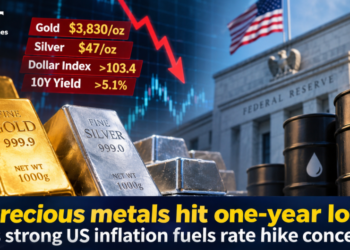
Gold prices have declined sharply from their January 2026 peak, falling 28.8% to their lowest level of $3,856 per ounce, according to a report by Kedia Advisory dated November 17, 2026. The latest correction marks the 13th time gold has fallen by 20% or more since 1980.
The report, titled Gold Crash & Rally Cycles, highlights that gold has experienced several major corrections over the past four decades. However, every completed decline of 20% or more was followed by a recovery of at least 20%.
Gold reached a record high of $5,416 per ounce in January 2026. Since then, prices have dropped 28.8% over approximately 9.6 months. During this period, gold touched a low of $3,856 per ounce, while its latest closing price stood at $3,878.
Gold’s historical crash cycles
The historical data show that gold has experienced 13 declines of 20% or more since 1980. Of these, four declines were particularly severe, exceeding 40%.
The median decline across these cycles was 30%, measured from the peak to the bottom. The average experience was followed by a strong recovery, with the median gain from the bottom reaching 69.4%.
The report also shows that gold recorded a median gain of 29.7% within one year after reaching the bottom. The median gain increased to 55.3% within two years.
2022-2026 rally was the strongest
Gold’s rally from September 2022 to January 2026 was one of the strongest periods highlighted in the report.
During this period, prices increased from $1,622 to $5,416 per ounce, registering a gain of 233.9% over approximately 3.3 years.
However, the latest correction has erased a significant portion of those gains, with gold now trading well below its January 2026 peak.
Recovery does not always mean a return to the previous peak
The report also highlights that gold does not always recover its previous record immediately after a major decline.
Gold moved above its previous peak in only six of the 12 completed crash-and-recovery cycles. In some historical cases, it took between 18 and 28 years for prices to regain earlier highs.
The current decline, which started in January 2026, is still ongoing and has not yet formed a completed cycle.
Overall, the historical data show that major corrections have been a regular feature of the gold market. While previous declines were followed by recoveries, the time required to regain earlier highs varied significantly across different cycles.