

DBT Bureau
Pune, 24 Feb 2026
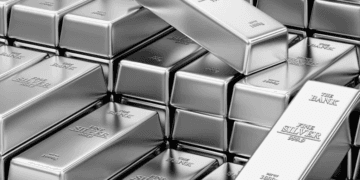
Silver spot prices stabilized after pulling back from their late-January record high, supported by tightening global supply, a low interest rate environment from the U.S. Federal Reserve, and persistent geopolitical tensions continue to offer floor.
- Silver prices retreated after reaching an all-time high in late January, with both London spot and COMEX benchmarks falling roughly 14% over the past month.
- The gold–silver ratio slipped to around 58.83 on Monday. The ratio fell below 50 in January, a level last seen in 2012.
- Global the market is expected to remain in deficit for a sixth straight year in 2026, with a shortfall of around 67 million ounces. -The Silver Institute
- Registered silver stocks on COMEX have fallen below the critical 90 million ounce threshold to 88,191,059.264 ounces, while eligible inventories have declined to 278,065,980.223 ounces.
- COMEX money managed positions have decreased significantly, with long positions dropping by roughly 79% yoy. Market has seen a reduction in both long and short positions, suggesting a more cautious or reduced-exposure sentiment among traders.
- China added silver to its rare earth minerals list and started export restrictions from January 2026.
- U.S. Geological Survey (USGS) included silver in its 2025’s final List of Critical Minerals.
- Global equities were mostly over positive territory in the last week.
- US dollar strengthened against a basket of six rivals amid last week.
- Indian rupee slipped against USD to near 90.70 points last week.
- U.S. CPI data showed inflation slowed more than expected in January, easing to 2.4%.
Silver Spot Hit New Record at the Start of 2026 Silver surged to multiple all-time highs in January, following an impressive 146% return in 2025, and briefly breaking above the key psychological threshold of USD100 for the first time. This sharp rise pushed the gold–silver ratio below 50, its lowest level since 2012. Although silver later pulled back to near USD63.00, the prices exhibited resilience. The factors that supported silver’s rally through most of 2025 have remained firmly in place this year. Tight physical supply in London, heightened geopolitical volatility, uncertainty surrounding U.S. policy continue to underpin the metal. Moreover, silver’s fundamental supply–demand balance remains constructive. The market is projected to remain in deficit for a sixth straight year in 2026.
Global Silver market to post 6th straight yearly deficit in 2026 According to The Silver Institute, the global silver demand is expected to remain stable in 2026, as stronger retail investment will largely offset declines in jewelry, silverware, and industrial consumption. Coin and bar demand has strengthened in recent months, while global ETP holdings stand at an estimated 1.31 billion ounces. Industrial fabrication is projected to fall by 2% to a four-year low of 650 million ounces, driven mainly by reduced silver use in photovoltaics (PV). Although solar installations will keep rising, ongoing thrifting and substitution away from silver will lower PV demand. However, structural growth sectors, including data centers, AI-related technologies, and the automotive industry, will continue to provide support. Jewelry demand is set to fall more than 9% and silverware demand about 17% in 2026, with high prices hitting India hardest, while China remains the only major market expected to see a rise in jewelry consumption. In contrast, physical investment demand is expected to climb 20% to 227 million ounces, reaching a three-year high.
Meanwhile, Global silver supply is projected to rise by 1.5% in 2026 to a decade high of 1.05 billion ounces, supported by a 1% increase in mine production to 820 million ounces from existing and newly commissioned projects, growing by product output from gold mines, and a 7% jump in recycling that will push secondary supply above 200 million ounces for the first time since 2012. Despite this growth, the market is expected to remain in deficit for a sixth straight year, with a shortfall of around 67 million ounces, reinforcing reliance on above ground inventories and adding strain to an already tight physical market.
Silver as a Critical Mineral
China began tightening silver export controls in late 2025, with full restrictions taking effect on January 1, 2026, tightening global supply just as the U.S. boosted silver’s strategic importance by adding it to the 2025 USGS Critical Minerals List in November.
iShare Silver ETFs holdings increased in February
Total physical holdings of Silver backed ETFs with iShare silver trust posted an increase nearly 2% so far in February after a 5.6% decline in January. The total physical holdings in silver with iShare silver trust is around 508 million troy ounces in the week ended 20 February.
Outlook
The key forces that lifted silver prices in 2025 are expected to continue supporting the market in 2026. Strong industrial demand driven by rapid digitalization, AI expansion, and growth in data centers and IT infrastructure, is boosting the need for silver-intensive computing and electrical systems. At the same time, tight physical supply, geopolitical instability, U.S. trade policy uncertainty, and concerns over Federal Reserve independence are sustaining bullion’s safe haven appeal. Meanwhile, strength in gold should help cushion downside risks for silver, even as elevated price volatility remains likely in the near term.
Technical View
LBMA Spot: MACD shows signs of convergence, while the Relative Strength Index (RSI) remains below overbought levels, indicating the potential for range bound trading in the near term. However, a clear break below $80 per troy ounce could signal near term weakness.
MCX Silver: Prices are expected to remain largely range-bound, though a brief correction cannot be ruled out. A decisive break below Rs.255,000 per kilo could signal the potential for short-term weakness.
Disclaimer: Any views, opinions, or investment-related information expressed by contributors on Databiztimes.com are solely their own and should not be construed as investment advice. Readers are advised to consult SEBI-registered or certified financial advisors before making any investment decisions.